













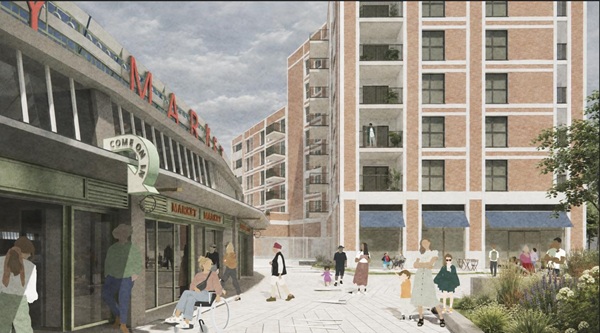
Placemaker, designer, ‘all-round development botherer’ and artist Alexis Butterfield paints distinctive visions of the streets and buildings where he lives in Liverpool, informed by his years working in the sector. He spoke to Newstart about the layering of complex spaces.

Image: Alexis Butterfield
Hello Alexis. You were until recently a partner at placemaking specialist Pollard Thomas Edwards. What did that involve?
My background is in regeneration. When I started out, almost 30 years ago, I was working on estate regeneration programmes, working with local authorities and housing associations on things like stock transfers and comprehensive development with a percentage provided as different affordable tenures. But I did all sorts of work. Pollard Thomas Edwards is a mid-sized practice of about 60-70 people and has a wide range of clients — a lot of local authorities, housing associations, venture partnerships and different groups.
Before all that, you trained in fine art.
Yes. Fine art printmaking in particular. I didn’t think there was much of a career in that, at least not for me.
But in the past few years you’ve found your way back into being an artist.
It’s interesting: I realise that I didn’t mention architecture in my preamble just there. When I was leading these kinds of projects, the thing that bothered me intensely, that kept me up at night, was what you might call the ‘legacy of place’. You want to make a place that will work as somewhere for people to live and grow well into the future. That’s what gets you into this world in the first place. The best work always comes from being fully involved with the existing communities in those spaces. It’s that mix of vision and human connection.
Yet the reality is that you’re often focused on money, and there are a whole load of cogs and mechanisms involved in the process to get the numbers and logistics right, and keep the various partners on board. All your creative energy goes into that side of things, to keep the show on the road. Or that was what I was finding.
So what changed?
Lockdown. There are people I know who got furloughed and had a lovely time finding creative things to do with their time, like making pottery – and good on everyone who did that. But I was one of those people during lockdown who ended up working round the clock, seven days a week for more than a year, to keep projects going. I put all my energy into that, I felt it was important – but I realise now it took a toll.

Image: Chester Castle
Then my wife’s father was ill. My wife and I were both largely working from home, so we decided to move from London to Liverpool to be nearer to him. I got involved in doing up our new home, and that underlined what I think I already knew I was missing – the joy I’d got from the fine art stuff I’d not done since my early 20s. Essentially, I swapped doing up the house for a smaller paint brush.
You were still working as an architect at this point.
Yes, five days a week and painting at weekends. But I really got into it and got some good responses to the work. Then I cut down to working four days a week, and slowly transitioned to doing more and more art. I left the firm last month and am now a full-time artist, at least for the time being. We’ll see how it goes.
Then it’s been a gradual process.
It involved a steep learning curve – my own process as an artist, the mechanics of the art world for selling prints and paintings, all the things that are involved. But there wasn’t one big epiphany where I made this drastic change. I think it’s more about little epiphanies every day: you see a particular bit of wall, or a colour against a mark, or the way one thing contrasts with another. But I can also see now that I needed to make a change. I’d yearned for a while to have the creative freedom to be able to respond on that kind of level, rather than having to win over an accountant or planning committee. I think anyone working in this sector feels like that at times, but I was bursting at the seams.
You’re producing pictures of the buildings and streets in the neighbourhood of Liverpool where you live. How do you decide on your subjects?
I sometimes go out for a walk with the aim of finding something particular – like, say, a Victorian building but with something modern in the same view. I’ve a good idea of what’s here, not least because I’ve walked it a lot. But increasingly, the walk is itself a journey of discovery. Walking is quite slow, so you have time to take in a lot. It might be an architectural detail, or the way two things look together, such as the contrast between one building that’s been cared for and, next to it, one that’s been neglected. Sometimes it’s just about a colour or colours I’ve seen. There’s also time to think – about what I observe in the street, but also about what might be going on in my life or the news. That can prompt a piece of work, too.

Image: The Hotel California, Birkenhead
One thing that haunts me a lot – and I think a lot of people – is the feeling that we’re living in a time when those who make decisions don’t have much sense of legacy, of what we’ll leave behind us as a society. We’ve lost something of the need, if you’ll forgive the cliche, to plant acorns that we ourselves won’t see grow up to be oak trees. But when I look at the old buildings around here, in which many of us still live and work, that sense is right there. The Victorians built things to last beyond themselves.
So you’re looking at these buildings as they are now and as they were when they were built.
It’s about exploring those kind of layers. What I care about in a building isn’t just what it looks like. Its history and purpose are important, too – what it was intended for and how it was actually used. When you look at a building you can see complex layers of different use, of different people who added details or made it their own.
That human element is really important. Often, I think we respond to the built environment, to a place, as if it’s somehow there by accident. But if you work in my profession, you know that every single thing is a fight. Every detail of a building was either an achievement or disappointment. It will have been thought about, designed, made, adapted, paid for. It might even have been loved. That’s something I try to explore in the way I make my pictures — the human-made aspect of the world. That’s why it’s vital to walk around and engage with it, as a human. With one of my first paintings, I even painted around my own hand as part of the composition. I hoped that would remind the viewer that a human being made this picture, but also the building in the picture, too.
You’ve been working like this for more than two years now. How has the art affected your perspective on the built environment?
That’s really interesting. At one level, these ideas were buzzing around my head for decades as I did the job. I’d have to write an analysis of a given place and the layers I could read into it – there are all sorts of ways to read a place – so that perspective came out of working practice.
What’s changed, I think, is that I’m much more aware of the different choices we make in creative work – whether that’s painting a picture or building a space for people to live. It’s often fraught and contingent. You find yourself thinking what the audience will want, or you’re exhausted with fatigue and it’s just about getting the thing finished. Sometimes you struggle to create the thing as you saw it in your head. There are the properties of the materials you work with, and your own skill and experience, and there’s a big element of luck. So many different elements interact, from the pragmatic to the personal, that creative work is all a kind of collage.
Or construction.
That’s exactly the word. It’s a physical construction, working within the limits of what’s possible. One reason I moved from fine art into architecture is that I’m quite cack-handed. It’s only got worse as I’ve got older – I never hold a paintbrush the right way. But I’ve realised that’s absolutely fine because I’m part of the material in the process. That’s really changed my sense of my own role in things I’ve made, even looking back to my time as an architect.
What response do you get to your work? People from Liverpool must recognise the streets and buildings. Do you make them see these places differently?
I’m not sure that I do. People are saturated in images anyway. There’s also a kind of Instagramification of imagery, where we look for reassurance in pictures on our phones. I think I see something of that when people look at my work. They love recognising where they live, or somewhere they used to know. They’ll say to me, ‘Oh, I used to walk that way to a job I had; it’s taken me right back.’ And it’s not just the place but the world they were part of. In that sense, they add their own layers to what’s in the picture. Quite often, when people buy a piece of my work it’s because they have that kind of personal connection to what’s shown. There’s a feeling of belonging.

Image: The Georgian Quarter
But now you ask me, I think maybe there’s more going on in the way people respond. They’ll be just as taken by the way a piece isn’t like the place they know. I’ve moved around styles quite a lot but I think my work is distinctive and I use a lot of colour. People’s perception of and response to colour is really interesting. Often you can make a place feel completely different just by altering colour. I think that’s the thing that makes them look again. The style and subject are reassuring but the colour makes it new, even a little unsettling.
Is the idea to show a kind of potential version of the place – a vision of what it could yet become? In that sense, your work is showing the past, present and future.
It’s not as linear as that. I’m really interested in otherness – a version of place that isn’t the one right in front of us. It’s a sort of sub-reality, made through collage. You understand the space and construction by seeing the different layers and choices.
You can see more of the work and buy prints and original art here. ‘The Land Across The Water’, a solo exhibition of Alexis Butterfield’s recent paintings of the Wirral and Chester runs at the Everyman Theatre on Hope Street in Liverpool, September 2-14.
Images: Alexis Butterfield
Other features:
Why regenerative design is the next chapter for the built environment
Leave a Reply